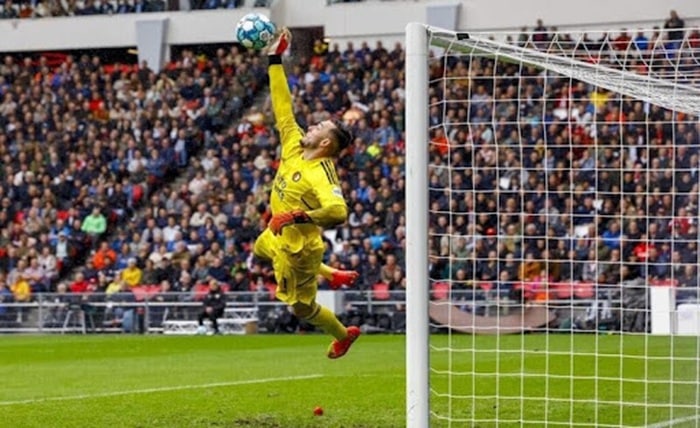
Football is a team-oriented sport in which every player has a specific responsibility but must coordinate closely with teammates. Depending on the tactical formation, the coach can position players in different roles to create a balance between defending, possession, and attacking. Understanding Football positions will help fans follow the flow of a match more easily and recognize the role of each player on the pitch.
Football Positions
Goalkeeper – The Protector of the Goal
The goalkeeper is the only player allowed to use their hands within their team’s penalty area. Their most important task is to prevent the opponent from scoring, while also organizing the defense and helping build play from the back.
A modern goalkeeper needs not only good reflexes but also strong footwork and ball-playing ability. When the team has possession, the goalkeeper can become the first passing option for building play from the back. Goalkeepers who can deliver accurate long passes can also help their team quickly transition into attack.
In addition, anticipation, catching high balls, and handling one-on-one situations are also very important. In decisive matches, an outstanding save from the goalkeeper can sometimes completely change the course of the game.
Center-Back – The Shield in Front of the Goal
The center-back plays in the heart of the defense and is primarily responsible for stopping opposing forwards. This position requires excellent tackling ability, reading of the game, and positional awareness.
A good center-back needs to know how to track forwards, intercept passes, and deal with aerial balls. They must also be able to provide cover for teammates when full-backs move forward.
In modern football, center-backs also play a significant role in building attacks. Players with good passing ability can move the ball beyond the opponent’s first pressing line and create attacking opportunities. This is also why viewers of keo bong da truc tuyen often pay attention to the quality of a team’s defense when assessing its strength.
Full-Back – Versatile Players
Full-backs operate along the left and right flanks. Their task is to stop opposing wingers while also regularly moving forward to support attacks.
In four-defender formations, full-backs can make overlapping runs, deliver crosses, or combine with wingers. When their team loses possession, they must quickly retreat to help restore a stable defensive structure.
Today’s top full-backs often possess speed, stamina, and excellent technical ability. Some players can even move into central areas to participate in possession. Fans following 90Phut TV will easily notice that this position is becoming increasingly important in modern tactical systems.
Defensive Midfielder – The Shield in Midfield
Defensive midfielders usually play in front of the defensive line and are responsible for protecting the central area. They are the first defensive layer when the opponent launches an attack and frequently provide support to the center-backs.
A good defensive midfielder needs to be able to read the game, win challenges, and recover possession. They must also be capable of making simple and accurate passes to maintain their team’s control of the ball.
In many systems, the defensive midfielder also acts as a link between the defense and midfield. When the team transitions, this player can quickly pass the ball to a central midfielder or winger.
Controlling the central area directly affects a team’s ability to defend and build play. Therefore, the bảng xếp hạng bóng đá of major competitions often shows that teams with a strong midfield are better able to maintain stability.
Central Midfielder – The Brain of the Midfield
Central midfielders operate across a broad area in the middle of the pitch and regularly contribute to both defense and attack. This position requires strong physical fitness, tactical intelligence, and accurate passing ability.
During possession, a central midfielder can receive the ball from the defense and distribute it to either flank or move it forward. When possession is lost, they must quickly apply pressure to limit the opponent’s ability to counterattack.
A well-rounded central midfielder can make a difference through line-breaking passes, long-range shooting, or runs into the penalty area. This is why many top teams always prioritize building a highly mobile midfield.
When watching 90 Phút TV, viewers can clearly observe how central midfielders control the tempo of a match, from safe passes to quick attacking transitions.
Attacking Midfielder – The Link to the Forwards
An attacking midfielder usually plays behind the forward and is responsible for creating decisive passes. They need good individual technique, vision, and the ability to process situations quickly.
When the team has possession, the attacking midfielder can move between the lines to find space. If they receive the ball in a favorable position, they can pass to the forward, combine with a winger, or take a shot themselves.
This position is particularly important against opponents who defend deep. A creative attacking midfielder can break down a defensive system with a single pass or an unexpected piece of skill.
People interested in keo bong da truc tuyen also often pay attention to the form of attacking midfielders because their creativity can directly affect the number of scoring chances a team creates.
Winger – The Attacking Threat on the Flanks
Wingers operate on both flanks and are often tasked with stretching the defense. They can use their pace to beat opposing defenders or cut inside to take shots.
A right-footed winger can play on the left wing and vice versa. This arrangement allows players to move inside more easily and shoot with their stronger foot.
In addition to scoring goals, wingers must also know how to combine with teammates and create chances. Cutbacks, crosses, and passes back toward the second line can all create dangerous opportunities.
In 90m TV, matches featuring fast wingers often produce many exciting situations because this is an area where numerous one-on-one battles take place.
Striker – The Main Goal-Scoring Threat
The striker usually occupies the highest position in the formation and is the player expected to score the most goals. They must know how to position themselves, make off-ball movements, and capitalize on opportunities inside the penalty area.
A traditional center-forward usually has a strong physique and excels in physical duels and aerial challenges. Meanwhile, a modern forward may move into wider areas, drop deep to receive the ball, or participate in pressing from the front.
The ability to finish with both feet, head the ball, and handle the ball in tight spaces are important qualities. An elite striker must also know how to attract defenders and create space for teammates.
The number of goals scored by forwards often has a significant impact on team performance and position in the football standings. Therefore, the striker’s efficiency is always one of the statistics that fans pay the most attention to.
Football Positions Change According to Tactics
Not every team uses players in fixed positions. With the development of modern tactics, a player can take on several different roles depending on the situation.
A full-back can move into central areas to support the midfield. A defensive midfielder can drop between two center-backs to help build play. A winger can move into central areas to create space for the full-back.
This shows that Football positions are not simply fixed areas on the pitch but also depend on how the coach structures the system. When watching 90P TV, viewers can observe constant positional changes during attacking and defensive situations.
Tactical Formations Determine Player Positioning
A team can choose a 4-3-3, 4-2-3-1, 3-5-2, or many other formations. Each system requires players to perform different tasks.
The 4-3-3 formation usually consists of one goalkeeper, four defenders, three midfielders, and three attacking players. Meanwhile, the 4-2-3-1 uses two defensive midfielders behind one attacking midfielder. The 3-5-2 features three center-backs and two wing-backs operating across a wide area.
Tactical flexibility makes football unpredictable. A team may start a match in a 4-3-3 formation but switch to 4-5-1 when defending.
Fans following keo bong da truc tuyen can use the formation and player positioning to identify whether a team is prioritizing attack or defense.
The Role of Each Position in Team Success
No position is completely independent in football. An excellent goalkeeper needs support from the defense, center-backs need protection from defensive midfielders, while forwards need quality passes from the midfield.
Coordination between positions determines how effectively the entire team operates. When the lines maintain appropriate distances, the team can control the match and limit the spaces available for opponents to exploit.
This is also why the football standings do not simply reflect the quality of a few individual players but also demonstrate the overall effectiveness of the entire team. Teams with balance between their lines tend to maintain more consistent form throughout the season.
Conclusion
Football positions form a closely connected system, ranging from goalkeepers, center-backs, and full-backs to midfielders and forwards. Each position has its own responsibilities, but all are aimed at the common goal of controlling the match and securing victory.
When fans understand the role of each player, they can analyze tactics more easily and appreciate matches on a deeper level. Platforms such as 90Phut also help viewers access numerous matches and observe how teams operate their formations in real match situations.