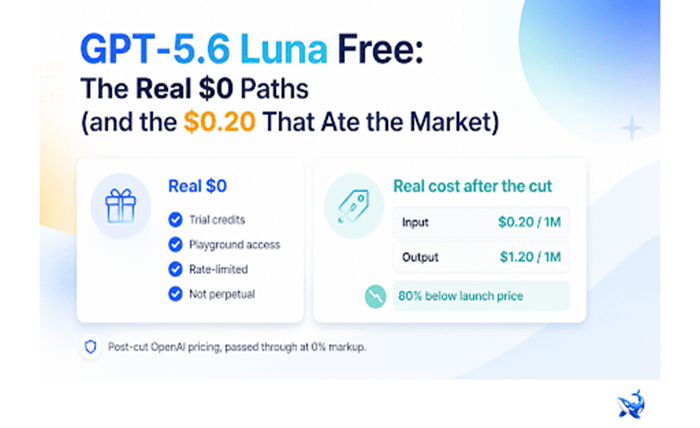
GPT-5.6 Luna API is OpenAI’s economy-tier reasoning model, released July 9, 2026, per Artificial Analysis, and “free” for it means one of two things: trial credits and playground access that are genuinely $0 but rate-limited and non-perpetual, or the post-cut API price of $0.20 input / $1.20 output per million tokens — an 80% cut from the launch price, per OrcaRouter’s catalog. That second number is the real story, and GPT-5.6 Luna is where the live rate card and telemetry sit. This article is the straight answer to “can I get Luna for free — and should I.”
Search “gpt 5.6 luna free” and what comes back is a wall of half-truths: expired free-tier screenshots, forum threads arguing over token math, and almost nobody stating the one fact that matters — that the paid endpoint is now cheaper per token than the free version of most things you’d want to run it inside. Let’s separate the genuine $0 from the stuff that only sounds free.
What “free” actually means for Luna
Start with the honest part, because it kills the most common misunderstanding. There is no perpetual free API tier for Luna. What OpenAI offers is trial and rate-limited free access — playground credits and similar — and those are real $0 paths, but they are time-boxed, quota-capped, and not something you can build a product on. That framing comes from OpenAI’s own materials as covered in OrcaRouter’s pricing analysis; treat any post claiming an unlimited free endpoint as fiction.
One genuinely free product tier does run on Luna: Replit’s Free Mode, which OrcaRouter’s own analysis confirmed is Luna-powered. That is a real way to use Luna at $0 — but it’s a product tier, not an API, with the caps and conditions that free tiers carry. The distinction matters: free product access is excellent for kicking the tires; it is not a substitute for an endpoint you control.
The model itself earns the tour. It carries a 1,000,000-token context window (1M), per Artificial Analysis, which flags it as multimodal — text and image input, text output — and “notably fast.” That context window is the strongest argument for Luna in high-volume work: one connection, a million tokens in flight, no chunking gymnastics.
The $0.20 that ate the market
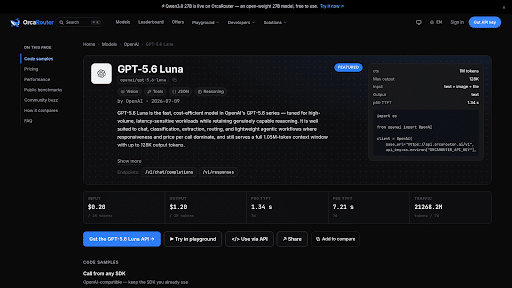
Here is the number that changed the conversation. After the cut, Luna is $0.20 per million input tokens and $1.20 per million output — roughly 80% below the $1/$6 launch price, per OrcaRouter’s catalog, which reflects the vendor’s post-cut rate card. The rest of the family moved less: Sol stayed at $5/$30, and Terra came down from $2.50/$15 to $2/$12 (about 20% off), per the same source. Luna took the deep cut because Luna is the volume play.
Now the comparison most coverage skips. A “free” tier on a consumer AI app is not free after you outgrow it — the overage is metered, and per token it is frequently pricier than Luna’s cut rate. At $0.20/$1.20, you can stop optimizing around someone else’s free tier and just pay for a 1M-context endpoint with no quota games. That’s the real economics of “free”: free tiers make sense to start on, and the cut price makes sense to stay on.
One caveat before you quote prices at a meeting: pricing varies by listing. One outside directory shows Luna at $0.10/$0.60 with a separate tier above 272k prompt tokens, while OrcaRouter’s catalog and Artificial Analysis both read $0.20/$1.20. Our reference here is the cut price passed through at 0% markup.
| The “free” paths, priced honestly | ||
| Path | What you actually get | What it really costs |
| OpenAI playground / trial credits (vendor) | Rate-limited, time-boxed Luna access | $0 until exhausted; then full rate |
| Replit Free Mode (per OrcaRouter) | Luna-powered free product tier | $0 at low usage; caps above it |
| “Free” consumer apps’ overage tiers | Metered usage on their platform | Often more per token than Luna’s cut |
| Luna API after the cut | 1M-context reasoning endpoint | $0.20 in / $1.20 out, 0% markup via OrcaRouter |
What that price buys on the board
Price matters little if the model is weak, so look at the independent numbers from Artificial Analysis, checked August 22, 2026. Luna’s Intelligence Index is 52.32 on its max effort config — well above the tier median of 17 — against 63.05 for Claude Opus 5 (max) and 60.93 for GPT-5.6 Sol (max). That is an 8.6-point gap to the flagship at a 25th of the flagship’s input price, a trade most teams will take on volume work.
Speed is where Luna genuinely leads. Its median output speed is 156.6 tokens per second — among the fastest on the board, versus 61.8 for Claude Opus 5 and 73.7 for GPT-5.6 Sol, per Artificial Analysis — with time-to-first-token around 102 ms. Cost per Intelligence Index task is $0.05, the cheapest on the board (Claude Opus 5: $2.34; Sol: $1.23). Even running Luna through the full index, at $172.17 over 130M output tokens against a 60M tier median, is a rounding error next to a flagship. All figures are Artificial Analysis’.
OrcaRouter’s own seven-day telemetry tells the same “volume workhorse” story: Luna moved 21,271.6M tokens in seven days, by far the highest volume in that data set, at a p50 time-to-first-token of 1.33 s (p95: 7.32 s). For scale, DeepSeek V4 Flash — a genuinely cheap open-weight model at $0.15/$0.29 — did 13,374M tokens at a 444 ms p50. Luna is the busiest reasoning model in the set; that is exactly what an economy tier is for.
The workflow that works: free to prototype, Luna to produce
Concretely: use the trial credits and the playground to validate Luna on your actual workload — prompts, tool calls, that 1M-token context. That is the correct use of free. The moment you need reliability, quota, and volume, stop banking on free and buy the endpoint, because the math has flipped.
Run a real example with post-cut prices. A month of 100M input and 50M output tokens: 100M × $0.20/1M = $20, plus 50M × $1.20/1M = $60 — $80 for the month, per the cut rate. The same volume at the launch price would have been $100 + $300 = $400. An 80% cut is not a discount; it’s a different product category.
On cost, you want a distribution path that doesn’t add a margin on top of that cut price. OrcaRouter carries Luna at list price with 0% markup — the rate card above is literally what you pay — on the same OpenAI-compatible key as 200-plus models, with automatic failover and routing to a cheaper or faster model when the task doesn’t need a reasoning model at all. Whether you buy through the vendor’s own API or several third-party platforms, ask the same question: is the $0.20/$1.20 the price, or the price before a markup?
The takeaway
There is no perpetual free Luna API. What exists is real but bounded: OpenAI’s rate-limited trial credits and playground access, and Replit’s Luna-powered Free Mode. Use them to prototype. For production volume, the cut price is the cheaper path — $0.20/$1.20 after an 80% cut, per OrcaRouter’s catalog, which makes Luna’s paid endpoint cheaper per token than the overage tiers of most consumer “free” products. If your story is “many tokens, reasonable quality,” Luna at the cut price is the economy answer; if you need flagship reasoning, that’s Sol, and you’ll pay for it. Choose free for the experiment and Luna for the workload — and make sure the price you’re quoted is the price, not the price plus markup.
Sourcing note: post-cut pricing, the 80% cut, family-tier rates and the Replit Free Mode detail are from OrcaRouter’s catalog and pricing analysis as of August 22, 2026; the launch price and the free-access description reflect OpenAI’s own published materials. Release date, 1M context window, multimodality, speed, benchmarks and per-task cost are from Artificial Analysis, checked August 22, 2026. Latency and traffic figures are OrcaRouter’s own seven-day telemetry. All prices vary by listing and change without notice; confirm against your own account before relying on them.